
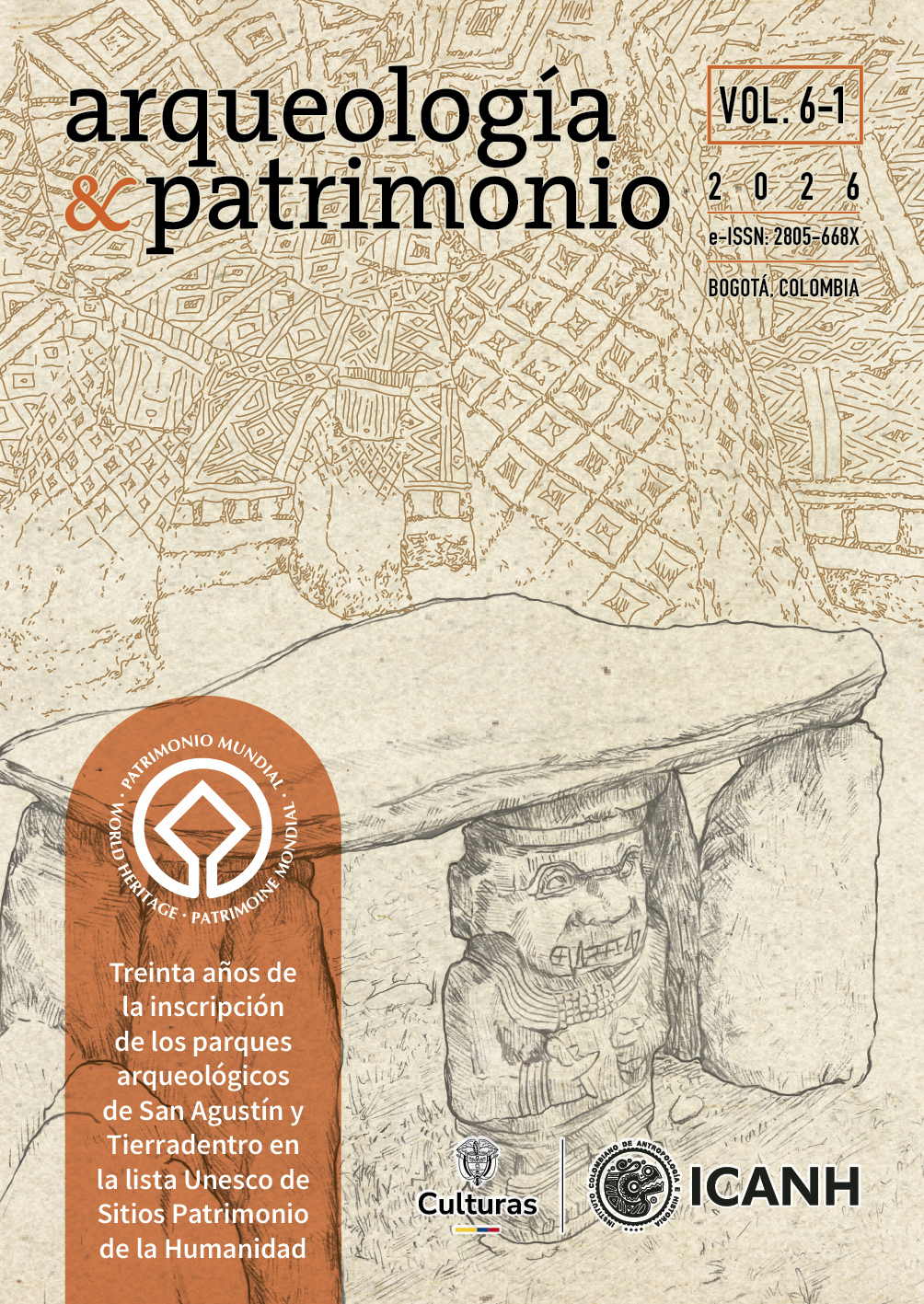
The Emergence of Colombia’s Cultural Heritage field: Revisiting the Development of the San Agustín Archaeological Park (1931-1939)
DOI:
https://doi.org/10.22380/26652773.3259Keywords:
archaeological park, heritage field, Law 103 of 1931, materiality, nation-state, San AgustínAbstract
This article analyzes the initial establishment of the San Agustín Archaeological Park between 1931 and 1939 as a key turning point in the development of the Colombian field of archaeological heritage. It examines how Law 103 of 1931 facilitated the transition from vague legislation to a legal framework focused on protection by formalizing the “public utility” status of archaeological remains and integrating them into the project of national identity. The text problematizes the historical and social context of Law 103, emphasizing the tensions between the administrative centralism based in Bogotá and the local realities of Huila, thus revealing a bureaucracy that frequently depended on personal connections and the social capital of political and intellectual elites. It also discusses the impact of scientific extractivism and intellectual colonialism practiced by foreign researchers through the exclusion of empirical knowledge and local communities from heritage management.
Downloads
References
Argüello, Pedro. 2025. “La guaquería en Colombia: historia de una práctica de larga duración”. Fronteras de la Historia 30 (2): 180-204. https://doi.org/10.22380/20274688.2825
Bourdieu, Pierre. 2001. Poder, derecho y clases sociales. Desclée de Brouwer.
Bourdieu, Pierre. 2002. Campo de poder, campo intelectual. Editorial Montressor.
Caldas, Francisco José de. (1808) 1942. Semanario del Nuevo Reino de Granada. Biblioteca Popular de Cultura Colombiana - Minerva.
Cámara de Comercio de Medellín. S. a. “Ricardo Olano Estrada”. 100 Empresarios. https://www.camaramedellin.com.co/cultura-camara/100-empresarios/ricardo-olano-estrada
Castellanos Valenzuela, Gonzalo. 2003. Régimen jurídico del patrimonio arqueológico en Colombia. Instituto Colombiano de Antropología e Historia.
Codazzi, Agustín. 1996. Geografía física y política de la Confederación Granadina. Estado del Cauca. Territorio del Caquetá. Obra dirigida por el general Agustín Codazzi. Editado por Camilo A. Domínguez Ossa, Augusto J. Gómez López y Guido Barona Becerra. Coama; Unión Europea; FEN; IGAC.
Comisión de Cultura Aldeana. 1935. El departamento del Huila; estudio de la Comisión de Cultura Aldeana. Imprenta Nacional.
Crellin, Rachel J., Craig N. Cipolla, Lindsay M. Montgomery, Oliver J. T. Harris y Sophie V. Moore. 2021. Archaeological Theory in Dialogue. Situating Relationality, Ontology, Posthumanism and Indigenous Paradigms. Routledge. https://doi.org/10.4324/9780429027147
Cubides, Fernando. 2002. “Representaciones del territorio, de la nación y de la sociedad en el pensamiento colombiano del siglo XIX: cartografía y geografía”. En Miguel Antonio Caro y la cultura de su época, editado por Rubén Sierra Mejía, 319-343. Universidad Nacional de Colombia.
Cuervo Márquez, Carlos. 1920. Estudios arqueológicos y etnográficos. Editorial América.
Fals Borda, Orlando. 1982. Historia de la cuestión agraria en Colombia. Carlos Valencia Editores.
Friede, Juan. 1943. Los indios del Alto Magdalena. Vida, luchas y exterminio 1609-1931. Ediciones de Divulgación Indigenista.
Gell, Alfred. 1998. Art and Agency: An Anthropological Theory. Oxford University Press. https://doi.org/10.1093/oso/9780198280132.001.0001
Gobernación del Huila. 2008. “Mandatarios”. 1.o de mayo. https://www.huila.gov.co/publicaciones/5028/mandatarios9-444/
González, David. 1976. Los paeces o genocidio y luchas indígenas en Colombia. Editorial La Rueda Suelta.
Gutiérrez de Alba, José María. 1873. “Tomo VIII. Expedición al Sur: Estatuas de San Agustín”. En Impresiones de un viaje a América 1870-1884. Biblioteca Virtual del Banco de la República. https://babel.banrepcultural.org/digital/collection/p17054coll16/id/469
Henderson, Jane. 2020. “Beyond Lifetimes: Who Do We Exclude When We Keep Things for the Future?”. Journal of the Institute of Conservation 43 (3): 195-212. https://doi.org/10.1080/19455224.2020.1810729
Holtorf, Cornelius y Annalisa Bolin. 2024. “Heritage Futures: A Conversation”. Journal of Cultural Heritage Management and Sustainable Development 14 (2): 252-265. https://doi.org/10.1108/JCHMSD-09-2021-0156
“La dinastía de los Santos”. 2010. El Espectador, 26 de junio. https://www.elespectador.com/politica/la-dinastia-de-los-santos-article-210505/
Langebaek Rueda, Carl Henrik. 2010. “Diarios de campo extranjeros y diarios de campo nacionales. Infidencias de José Pérez de Barradas y de Gregorio Hernández de Alba en Tierradentro y San Agustín”. Antípoda. Revista de Antropología y Arqueología 11: 125-161. https://doi.org/10.7440/ANTIPODA11.2010.08
Park, Hyung Yu. 2022. “Critical Approaches to Tourism, Heritage and Culture”. Tourism Planning & Development 19 (1): 37-49. https://doi.org/10.1080/21568316.2021.2021473
Pérez de Barradas, José. 1943. Arqueología Agustiniana: Excavaciones arqueológicas realizadas de marzo a diciembre de 1937. Imprenta Nacional.
Reyes, Aura L. 2017. “Ensamblando una colección. Trayectos biográficos de sujetos, objetos y conocimientos antropológicos en Konrad Theodor Preuss a partir de su expedición a Colombia (1913-1919)”. Tesis de doctorado, Freie Universität. https://doi.org/10.17169/REFUBIUM-6396
Rivero y Ustaríz, Mariano Eduardo de y Johann Jakob von Tschudi. 1851. Antigüedades peruanas. Imprenta Imperial de la Corte y del Estado. https://bvpb.mcu.es/
Robledo, Santiago. 2021. “Gerardo Arrubla, el Museo Nacional y las antigüedades indígenas”. Cuadernos de Curaduría (Museo Nacional de Colombia) 18: 47-87. https://www.academia.edu/51009631/Gerardo_Arrubla_el_Museo_Nacional_y_las_antig%C3%BCedades_ind%C3%ADgenas
Santa Gertrudis, fray Juan de. (1756-1767) 1956. Maravillas de la Naturaleza. Empresa Nacional de Publicaciones.
Smith, Laurajane. 2006. Uses of Heritage. Routledge. https://doi.org/10.4324/9780203602263
Smith, Laurajane. 2011. “El ‘espejo patrimonial’: ¿ilusión narcisista o reflexiones múltiples?”. Antípoda. Revista de Antropología y Arqueología 12: 39-63. https://doi.org/10.7440/antipoda12.2011.04
Stübel, Alphons. 1994. “Cartas de Alphons Stübel: Colombia”. Boletín Cultural y Bibliográfico 31 (35): 69-70.
Unesco. 1972. “Convention Concerning the Protection of the World Cultural and Natural Heritage”. World Heritage Centre. https://whc.unesco.org/en/conventiontext/
Walde-Waldegg, Hermann von. 1940. “Stone Idols of the Andes Reveal a Vanished People. Remarkable Relics of One of the Oldest Aboriginal Cultures of America Are Unearthed in Colombia’s San Agustin Region”. The National Geographic Magazine LXXVII (5): 625-647.
Downloads
Published
How to Cite
Issue
Section
License
Copyright (c) 2026 Arqueología y patrimonio

This work is licensed under a Creative Commons Attribution-NonCommercial-NoDerivatives 4.0 International License.